 en
en
 Support

This article first appeared in the winter edition of faktor magazine.
WLAN is one of those things that you only notice when it's missing—or when it's under attack. At the SerNet Forum, something that normally remains hidden became visible: a convenient wireless connection can become a target for attack.
WLAN is one of the quietest parts of IT. You can't see it, you can't hear it. Devices connect automatically, passwords are passed on, older systems continue to transmit undisturbed. Only when a stranger appears on the network or data is intercepted does it become apparent how open the wireless network is. At the SerNet Forum on October 1 at the Göttingen Media House, it became clear that the risks do not arise from criminal hacker attacks, but from everyday routines – in small businesses as well as in large corporations. Wireless networks, which we take for granted, need more attention – that was one of the key insights of the evening.
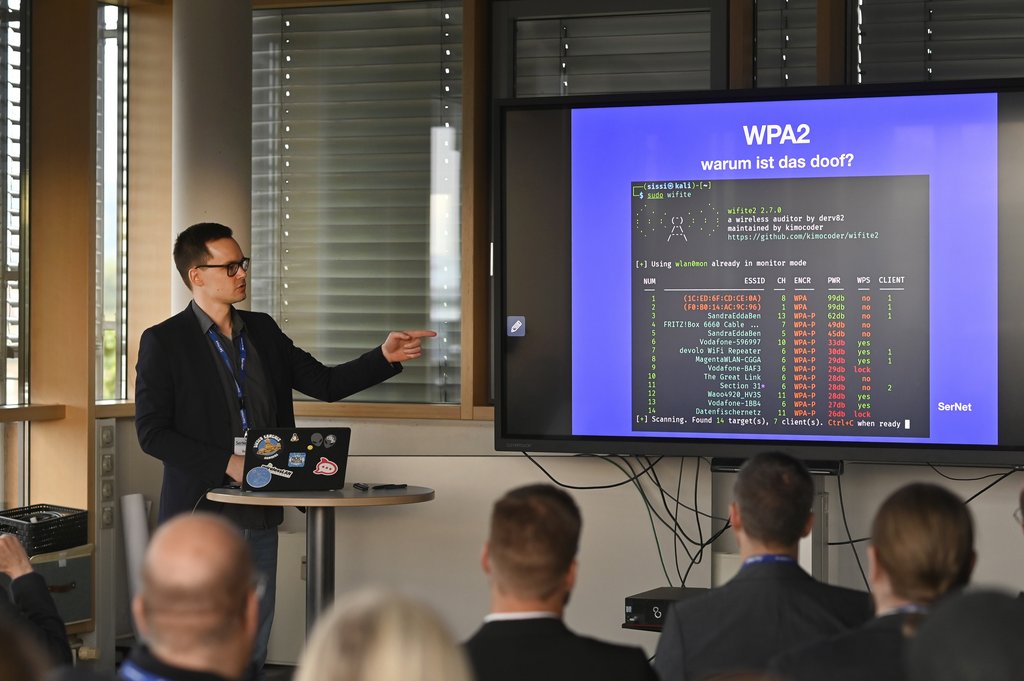
In his presentation “Secure wireless communication – secure operation,” Benjamin Körnig, WLAN expert at SerNet GmbH, showed how vulnerable a WLAN is in companies of all sizes. Körnig: “Many companies see WLAN as purely a connection to the outside world.” In fact, it is also a bridge to the inside – to servers, applications, telephone systems, or IoT (Internet of Things) devices that are indispensable in daily operations. An attack often begins inconspicuously: with a recorded connection setup from which passwords can be reconstructed. Or with a “malicious twin” that mimics the original network and intercepts data traffic. Many of the tools required for this are freely available.
The critical point is that attacks do not specifically target large or small companies. They target networks that are vulnerable. The consequences of an insecure Wi-Fi network are manifold and often linked to other, frequently undiscovered vulnerabilities:
- Unauthorized access to internal and personal data
- Manipulation of devices such as cash register systems, telephone systems, or IoT components
- Infiltration of malware via compromised devices Misuse of the Internet connection for spam or illegal activities
- Gradual penetration into central systems
The risks are similar for companies of all sizes—but their resilience differs. While large organizations are more likely to have contingency processes in place, a few days without cash registers, practice software, or order data can quickly get an SME into trouble. The basic expert recommendation is to consistently use modern encryption (WPA3), which makes many known attack methods significantly more difficult.
Keep an eye on your Wi-Fi – and check it regularly
According to Körnig, small and medium-sized companies in particular underestimate how attractive they are to automated attacks. One focus of the discussion was therefore the widespread use of standard home devices, which are used in many small organizations. Many of these devices do not allow operation with modern encryption alone, but only in a mixed mode. “Convenient to set up, but problematic in terms of security,” Körnig summed it up. Professional WLAN systems, on the other hand, are more stable, more secure and – measured in terms of potential damage – surprisingly cost-effective. They enable clean separation of networks, modern encryption, and clearly regulated access rights – the minimum security measures required in a business environment.
The message of the evening was therefore that security does not depend on the size of a company, but on how consciously a WLAN is operated. Those who know and, ideally, understand their own wireless network can make better decisions. Where technical depth or time is lacking, professional support is useful.
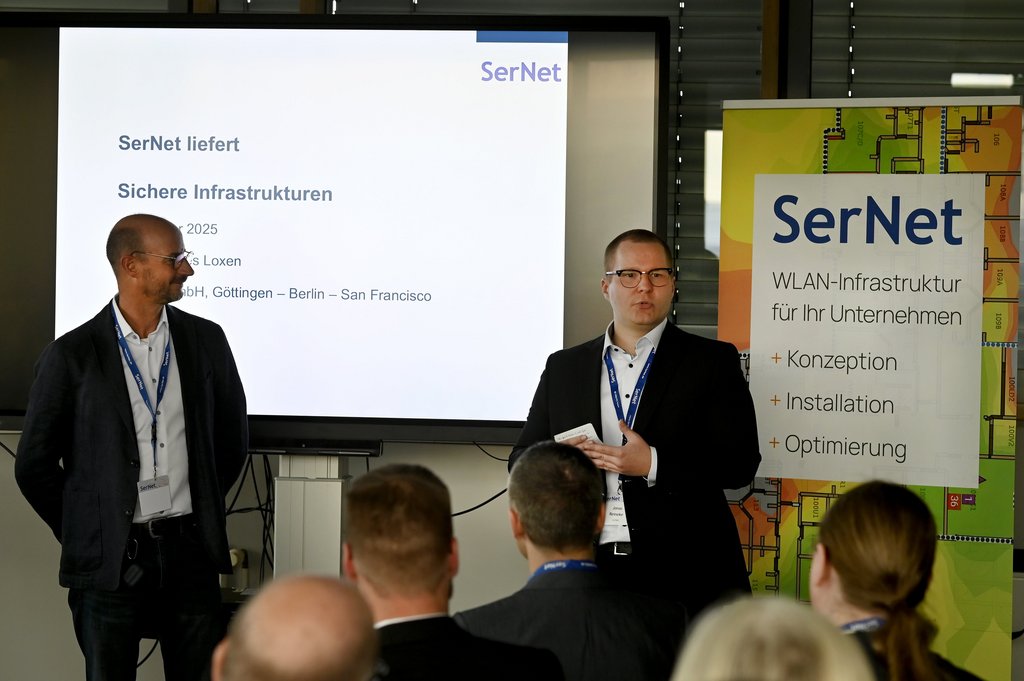
Dr. Johannes Loxen, founder of SerNet, explained how Wi-Fi fits into the big picture of IT security. Modern information security must be thought of “across all layers” – from infrastructure to network technology and identity management to governance and compliance.
WLAN is not a marginal detail, but a supporting layer: “Wireless networks are now part of a company's central infrastructure.” SerNet is happy to help here: from professional lighting and the selection of suitable hardware to secure configuration, including separate networks and access controls.
The SerNet Forum: Insight and exchange
The SerNet Forum regularly brings together people who have responsibility for IT in various roles or who deal with IT security: managing directors, specialists, and experts. The exchange is open, practical, and technically sound—a place where questions are asked and answers are found together.
The next SerNet Forum is in preparation – with topics that are relevant for companies of all sizes and combine expertise with dialogue.