 en
en
 Support

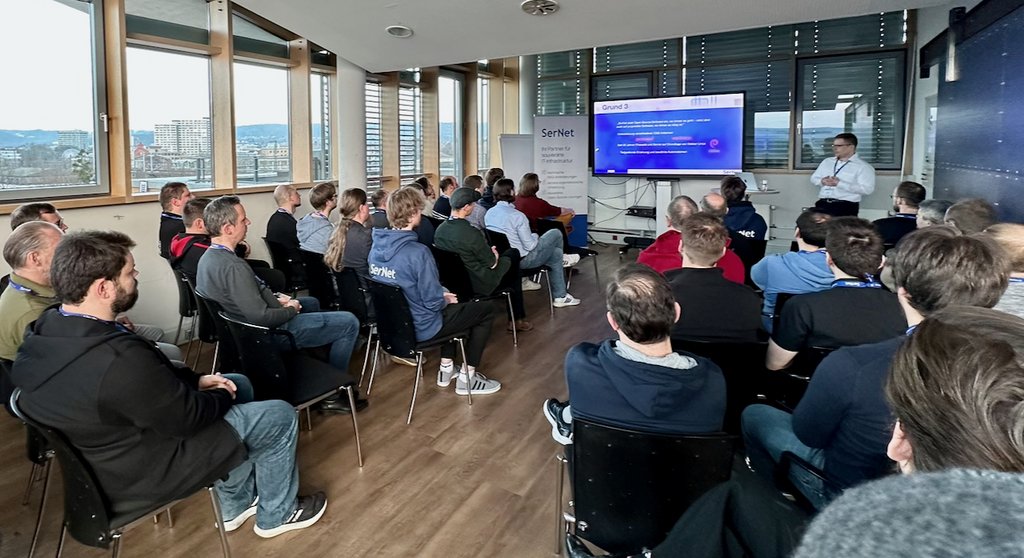
About 40 participants from companies in Göttingen attended the SerNet Forum in February 2026, because many IT teams are currently facing the same question: Should we continue with virtualization as before—or systematically evaluate alternatives? The focus was on licensing logic, vendor strategies, vendor lock-in, and thus the question of how predictable infrastructure planning will remain in the coming years.
This is particularly relevant for organizations with existing VMware environments, upcoming renewal decisions, or a desire to reassess dependencies and operating costs. For them, Proxmox VE is an option—especially when transparency, controllable licensing costs, and Linux-based operations are key criteria.
Why the topic is strategic again
Jonas Reineke (Team Lead for Secure Infrastructure) set the stage: Since Broadcom’s acquisition of VMware in November 2023, licensing and the portfolio have been restructured—with noticeable consequences for cost predictability, especially beyond traditional enterprise packages.
At the same time—driven in part by geopolitical developments—interest in greater digital sovereignty is growing: What dependencies arise, and which ones are we willing to accept? Reineke took a pragmatic approach: Open source where it makes sense—proprietary where necessary. In this logic, open source is not a label, but a lever for transparency, auditable components, and more manageable dependencies.
Proxmox in practice: from a lean entry-level setup to a cluster
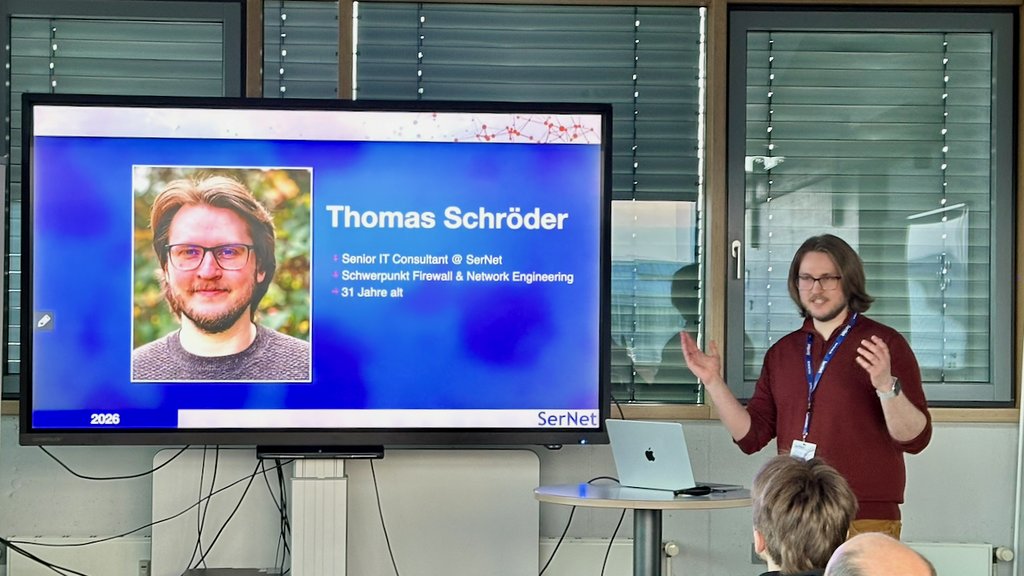
The practical demonstration was provided by Thomas Schröder (Senior IT Consultant). SerNet is currently testing Proxmox VE itself and is gradually migrating its internal virtualization. His key point: Proxmox scales remarkably broadly – from small test or entry-level scenarios on lean hardware to cluster or hyperconverged scenarios where compute and storage are tightly integrated. This breadth makes the platform interesting: it allows for a low-threshold entry point but can also support demanding operational models. At the same time, requirements must be clearly defined early on.
In his presentation, Schröder highlighted the key questions to consider before a migration: existing or new hardware, availability and performance requirements, reliable backups, and recoverability during the transition phase. The SerNet scenario also involved continuing to use existing ESX hosts, setting up Proxmox in parallel, migrating VMs step by step, and securing backup/restore processes. Schröder: “What matters is not that a backup exists, but that the restore works within the intended time window.”
The presentation made it clear: With Proxmox, success is not determined by a single feature. It is the interplay of the target configuration, network, storage, backup, and operations. Those who carefully consider these points together can use Proxmox in a highly flexible manner—but not arbitrarily.
Consulting from SerNet
Would you like to determine whether Proxmox VE, Hyper-V, or another operating strategy is right for your environment? Our sales team will sanswer all questions—from architecture and migration to hardware, storage, backup, and operations. If needed, SerNet also plans and procures the appropriate hardware infrastructure in collaboration with partners such as Fsas, ALSO, and Thomas-Krenn.
What is the SerNet Forum?
The SerNet Forum is SerNet’s series for admins, IT managers, and decision-makers in the region: featuring practical insights from projects and operations—and plenty of space for discussion.
Would you like to see a topic from your organization featured at the next SerNet Forum? Contact us.