 en
en
 Support

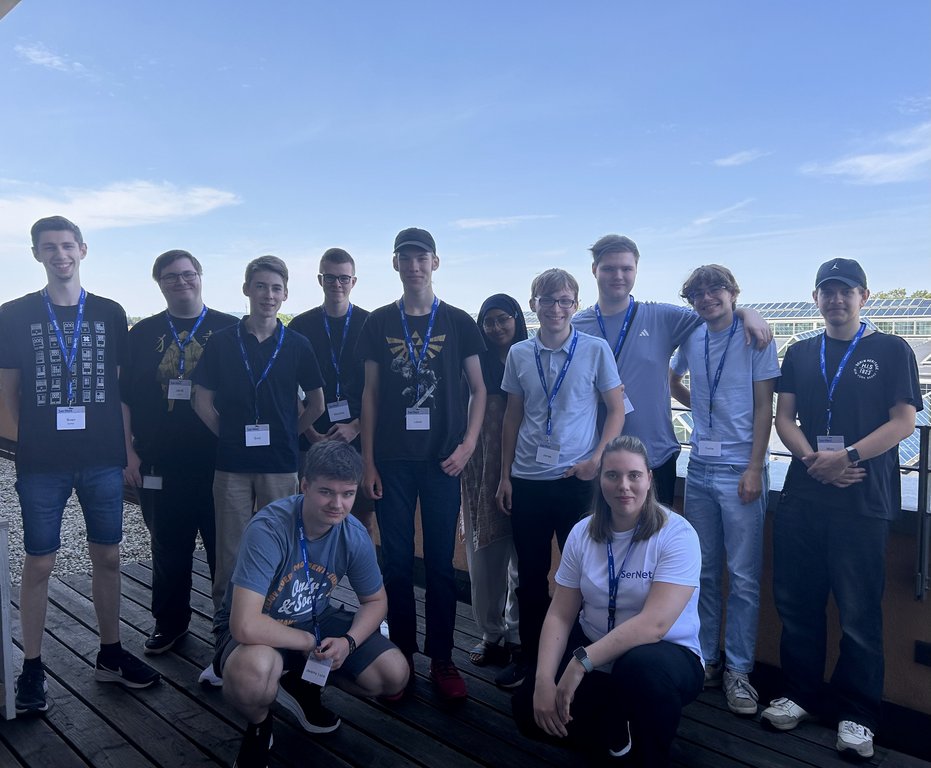
How does Linux work? What actually happens in a network? And how do a few commands and your first lines of code turn into your own project? From 3 to 7 August, ten participants with an interest in technology were able to find out exactly that at the five-day Linux.Camp at SerNet – through trial and error, tinkering, programming and collaborative problem-solving.
They were supported by trainees Janik Frese and Lätizia Braun, as well as trainers Jonas Reineke and Alexander Otte. Together, they organised a varied week in which technical fundamentals and practical applications were closely intertwined.
Trying things out rather than just listening
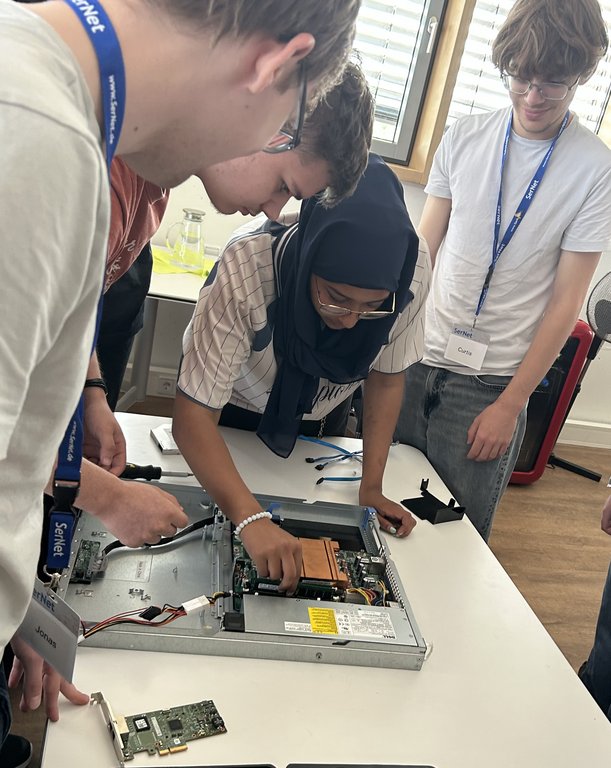
From the very start, the focus was on hands-on experience. Using Raspberry Pis, virtual machines and the Linux console, the participants familiarised themselves step by step with various areas of IT.
They learnt important Linux commands, accessed systems via SSH and worked with files, directories and permissions. What initially sounded rather abstract could thus be tried out and understood directly on their own systems.
From your own network to IT security
The topic of networks was also tackled in a practical way. What are IP and MAC addresses? Why do we need a gateway or a name server? And how do computers find each other in the first place?
To answer these questions in more than just a theoretical way, the group set up their own network and configured it themselves. Using Wireshark, the participants were then able to examine the data traffic in more detail and observe what information is transmitted within a network.
From there, it was only a small step to IT security. Malware, typical attack vectors, encryption and appropriate protective measures demonstrated why cybersecurity is not just an issue for businesses and IT professionals, but plays an important role in our everyday digital lives.
Websites, scripts and Raspberry Pis
Things got creative during the web development and programming sessions. The participants designed their own websites using HTML and, in the process, learnt about the Apache web server and Nextcloud, amongst other things.
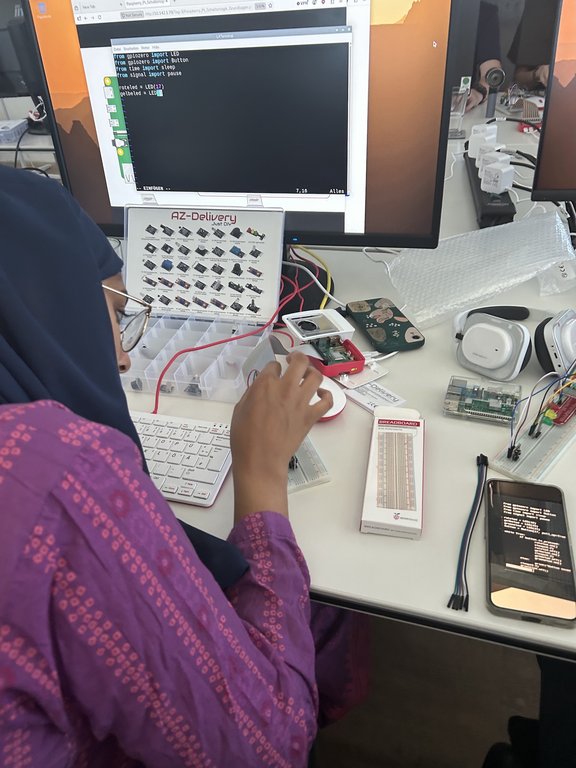
A backup script they wrote themselves also demonstrated how recurring tasks can be automated with just a few lines of code. Hardware and software also came together: a Raspberry Pi was used to control an LED strip.
The free programming sessions finally gave participants the space to explore their own ideas. There was no need to find the perfect solution to every task straight away. Experimenting, spotting mistakes, brainstorming together and finding a new approach were all integral parts of the concept.
Sharing knowledge and taking on responsibility
Linux.Camp offered an opportunity to learn new things, and not just for the participants. Janik Frese and Lätizia Braun were also able to take on responsibility and share their own knowledge. Together with their instructors, they guided the group through the week, provided support with projects and were on hand to help with any questions or challenges.
That is precisely what makes Linux.Camp so special: technology is not just explained, but experienced first-hand. Over the course of five days, the ten participants gained insights into a wide variety of IT fields and were able to discover what particularly interests them.
As a result, the week didn’t just leave them with websites they’d built themselves, configured networks, scripts and Raspberry Pi projects. Above all, the group took away many new experiences – and, hopefully, a desire to keep experimenting, programming and discovering technology for themselves.